RU · KZ · EN Request a proposal

NILNOT · Normative Research Laboratory for Labor Standards and Pay

Labor productivity growth without capital investment

Engineering System of Production and Labor Organization — lower cost of products, works and services

10–30 %labor productivity growth reserve across projects
1–3 mo.payback period
since 2007results of projects developed and accepted by clients

RESULT: labor productivity growth reserve across projects — 10–30 %

through comprehensive implementation of the Engineering System of Production and Labor Organization: technical labor standardization — labor standards handbooks (work procedure regulations, labor standards, standard headcount) by division and workplace; elimination of unproductive workplaces; rational production structure with reduction of redundant divisions, management levels and number of managers based on span-of-control standards; combination of trades and extension of service areas; pay for completion of a standardized task; optimal work regime and shift schedule — without capital investment.

For organizations with regulated tariffs and the quasi-public sector: standard headcount and standard labor costs — justification of personnel costs in the cost of regulated services and the basis of the tariff estimate (Labor Code of Kazakhstan, Art. 101(6)); separation of standard and above-standard labor costs under International Financial Reporting Standards (IFRS).

I. Result for the client

Typical risks and what the client receives

Financial

Typical risks

personnel costs above the standard requirement — higher cost of products (works, services); headcount and payroll “based on actuals”; no separation of standard and above-standard labor costs (IFRS); paying both own staff and contractors for the same types of work; paying for presence on shift rather than for the volume of work completed

What the client receives

Labor productivity growth through implementation of labor standards, a rational production structure (fewer management levels, no duplication or fragmentation of functions), combination of trades, extension of service areas (incl. multi-machine service), pay for completion of a standardized task, a work regime and optimal shift schedule suited to the nature of work, and an optimal work schedule — without capital investment. Financial results: lower cost — economic effect in tenge per month and per year; working time reserve and the corresponding released headcount — redistributed to core and auxiliary production without growth in headcount and payroll; standard technical and economic indicators (labor productivity, labor intensity of products (works, services), cost per standard hour, labor costs in the cost of sales, incl. under regulated tariffs) — basis for planning and scheduling; labor costs — per labor standards, above-standard costs — period expenses (IFRS); payroll — per standard headcount; standards for budgeting and the tariff estimate (Labor Code of Kazakhstan, Art. 101(6)); own staff or contractor — by labor intensity and economic feasibility.

Organizational

Typical risks

inefficient organization of the production process and labor, irrational staff deployment — loss of working time (unproductive work, unregulated breaks); idle running and downtime of equipment for organizational and technical reasons — underuse of production capacity; uneven workplace load — overtime in peak periods and idle time otherwise; night work without technological necessity — unjustified premium pay; duplication and fragmentation of functions, excessive management levels, managerial positions without their own object of management — redundant and unproductive workplaces, blurred responsibility; repair after failure without a PPM schedule — unplanned downtime, emergency repairs, overtime of repair staff

What the client receives

Engineering base: equipment classification and grouping regulation — repair complexity, the basis for service standards and maintenance and repair labor intensity; regulatory basis for the Regulation on planned preventive maintenance and servicing of equipment; process sheets and labor organization charts by type of work and equipment (composition and sequence of operations, crew composition) — together with the client’s specialists, the basis for worker training. Rational work regime: regulation on the standard shift working time balance; work regime and optimal shift schedules suited to the nature of work; summarized working time accounting with a justified accounting period; night shifts — only where technologically necessary. Rational structure: regulation on the production structure (sections, sub-sections, units) within the organizational structure; divisions by function and threshold headcount; span-of-control standards; each function assigned to a single responsible division; a management level — only where it has its own object of management.

Legal and HR

Typical risks

job and trade titles and qualification requirements not matching professional standards, ETKS and KS (Labor Code of Kazakhstan, Art. 101(8)); grades without tariff ranks — pay not linked to job complexity and labor standards; formal job and work instructions — not tied to the workplace and labor standards: scope of work and responsibility not fixed; incomplete workplace descriptions and, as a result, an incomplete list of hazardous and harmful production factors — risk of incorrect certification of production facilities for working conditions and claims by inspection authorities; loss of process knowledge when experienced staff leave — the process is not documented in process sheets

What the client receives

Personnel and working conditions: trades and positions per ETKS, KS and professional standards; grades linked to tariff ranks; organizational and technological workplace descriptions (scope of work, equipment serviced, raw materials, working conditions) — the basis for job and work instructions detailed per labor standards, and a complete list of hazardous and harmful production factors for certification of facilities and PPE. Labor accounting: per-shift work order (standardized task); per-shift accounting and payroll; working time timesheet.

I. Result for the client

What the client receives

Labor standards handbook for each division and workplace — labor standards, standard headcount, headcount summary and analysis; with an Excel calculation methodology — for independent recalculation by the client’s specialists when work volumes, equipment or structure change.

  • work procedure regulations (for managers, specialists and office staff — functional job maps) and labor standards by workplace: time standards for work operations, standard labor intensity, output standards, service standards for production facilities (equipment, production areas)
  • scientifically and technically justified number of workplaces and standard headcount (on-duty, relief, payroll) by function and division — based on work procedure regulations and time standards for all personnel categories; for repair staff — also by equipment repair complexity and standard maintenance and repair labor intensity
  • comparative analysis of standard and actual headcount — deviations for each workplace and their systemic causes

For the organization as a whole

  • Standards of production organization and production personnel management: division of labor, production structure and layout, span-of-control standards and rational management levels, grouping of facilities and divisions, personnel categories
  • Tariff pay terms and regulations: on labor standardization, on tariff pay terms, on working time accounting; timesheet and shift task / work order forms
  • Regulatory basis for process sheets and the Planned Preventive Maintenance Regulation: lists of operations, frequency and labor intensity of maintenance and repairs by type of equipment and work
  • written explanations in response to client questions at acceptance — with references to calculations
  • Final report: summary of standard headcount by staffing table with references to the labor standards handbooks; risks of keeping the current headcount and structure; phased implementation measures

II. The system

Engineering System of Production and Labor Organization

A set of labor standards, organizational standards and process documents calculated from the enterprise’s technology, equipment and production facilities, with each standard traceable to a process operation and recalculated when production conditions change. For groups of companies and enterprises with branches — a single corporate standard: levers to manage labor productivity, headcount and personnel costs in each organization (branch).

System logic

  1. function
  2. production process
  3. process regulation
  4. standard-setting factors
  5. work procedure regulation
  6. workplace
  7. labor standards (time, output, labor-intensity, service, headcount)
  8. category and grade
  9. standard number of workplaces and headcount (on-duty, relief, payroll)
  10. production division (section, shop)
  11. pay for results
  12. per-shift accounting and payroll
  13. cost

Economic effect — lower labor costs in the cost of products (works, services) as labor productivity grows faster than the average wage.

II. The system

System tools

Main tool

Technical labor standardization

(Labor Code of Kazakhstan, Art. 101) — determining the working time required per unit of output, volume of work or servicing of means of production under specific organizational and technical conditions; the only scientifically justified method for determining the required headcount and number of workplaces, assessing labor productivity and its growth reserves.

Principle: labor standards are set on the basis of technology. One end-to-end methodology for all industries.

Methods of setting labor standards: analytical-research — direct measurement at workplaces based on study of the technology: time study of typical operations or of the production process as a whole — to determine operating time; working time observation (individual, group, team), of the production process and of equipment use — to determine the structure of shift working time, losses of working time and equipment downtime; analytical-calculation — calculation from technology and standard-setting factors using cross-industry and industry labor norms, taking into account the client’s organizational and technical production conditions, process and equipment data sheet parameters.

Structure of the time standard: operating time (main and auxiliary) — from workplace study or calculation; preparatory and closing time, workplace servicing time, rest and personal needs — per cross-industry norms.

The work procedure regulation (sequence and duration of operations) and labor standards are the standard for performing work: the basis for measuring and sustaining improvements under lean production and kaizen.

Other tools (link in the system logic)

  1. Tariff pay terms and an effective pay system (category and grade, pay for results)

    grading of jobs per ETKS and KS, minimum tariff rate, tariff scale; time-bonus pay with a standardized task

  2. Improvement of technical and technological production preparation (process regulation, standard-setting factors)

    breakdown of process regulations to work operations — the basis for work procedure regulations; equipment classification and grouping, repair complexity — the basis for service standards and maintenance and repair labor intensity; where process sheets and a PPM Regulation are missing — the regulatory basis for developing them

  3. Division and cooperation of labor (function, production process, workplace)

    functional, technological, occupational and qualification division of labor; each function assigned to a single performer; individual and collective forms of labor organization

  4. Combination of trades (positions), extension of service areas and increase in work volume (labor standards, workplace)

    incl. multi-machine service — where equipment has machine (automatic) running time (Labor Code of Kazakhstan, Art. 111)

  5. Rational production structure (production division)

    production structure within the organizational structure; grouping of divisions by threshold headcount; span-of-control standards

  6. Rational work regime and working time balance (standard number of workplaces and headcount)

    optimal shift schedules suited to the nature of work; summarized accounting with a justified accounting period; standard working time balance

  7. Labor accounting (per-shift accounting and payroll, cost)

    per-shift work order (standardized task), timesheet; integration with 1C, SAP or another accounting system

Estimate for your enterprise

What the reserve is worth

Example filled with illustrative values. Average industry wage — per the Bureau of National Statistics of Kazakhstan.

Economic effect, KZT per month—
per year—
Working time reserve — equivalent workplaces—

Estimate, not an offer. Use of the reserve — at the client’s discretion: redistribution to core and auxiliary production; increase of the bonus fund for completing the standardized task within the payroll savings; vocational training of workers, specialists, managers and office staff. Exact calculation — after diagnostics.

III. Work procedure

Procedure, stages and scope of work

Pilot → whole enterprise

At the client’s choice — the whole enterprise or in phases, starting from a pilot (a division or branch); for a group of companies — a corporate standard.

Pilot project — one or two divisions; the pilot cost is credited towards the cost of work for the whole enterprise.

Whole enterprise — in phases: core production → auxiliary production → administrative and management staff; each phase is accepted separately.

Timeline and cost — individual: determined by industry specifics and the nature of work — types of production processes (manual, machine-manual, machine, automated, apparatus), type of production, number of shifts, geographic dispersion of facilities, number of trades, positions and workplaces, and the headcount and composition of divisions; stated in the commercial proposal.

I. Development

1. Diagnostics — study and analysis of the current organization of production and labor: technology, equipment use over time (working and idle running, downtime for organizational and technical reasons), use and loss of working time, overtime; structure, labor organization (staff deployment) and pay; duplication and fragmentation of functions, excessive management levels.

2. Labor standards — study of working time at workplaces and calculation of labor standards; labor standards handbook for each division and workplace: work procedure regulations, labor standards, standard headcount; draft staffing table; optimal staff deployment according to the production processes.

3. Standardization — standards of production organization and production personnel management: division of labor, production structure, span-of-control standards, grouping of divisions, personnel categories; Regulation on labor standardization.

4. Pay and labor accounting — tariff system; Regulation on tariff pay terms, Regulation on working time accounting; timesheet and shift task (work order) forms.

Regulatory basis: Labor Code of Kazakhstan — Art. 101 (labor standardization), Art. 107 (pay system), Art. 111 (combination of positions, extension of service area), Art. 71, 73, 75–77, 79 (working time regime, shift work, summarized accounting, night work, overtime, working time accounting); guidelines of the Ministry of Labor and Social Protection of the Population of Kazakhstan (No. 310-p, No. 530-p, No. 375/1-ө); unified cross-industry norms (No. 330). Every standard is justified by calculation — for approval in the procedure set by the Labor Code, inspections and labor disputes.

II. Implementation and support

  • testing of labor standards at workplaces, verification and adjustment — together with the client’s specialists; training in the labor standardization methodology during the work for engineering and technical staff (line managers and specialists) and for labor standards and pay specialists
  • approval of standards in the procedure set by the Labor Code of Kazakhstan
  • process sheets and labor organization charts — together with the client’s specialists
  • detailing of job and work instructions according to labor standards
  • automation — integration with 1C, SAP or another accounting system together with the client’s programmer
  • monitoring and revision of standards

Input data from the client (before the site visit): staffing table, organizational structure, regulations on divisions, job and work instructions; process regulations and process sheets, list of equipment with technical specifications, load by shift; equipment data sheets, PPM schedules, repair logs, contracts for works and services with third parties; shift schedules, working time timesheets, absence records.

III. Work procedure · stage II

Labor accounting and payroll — digitalization

Shift cycle:

  1. Start of shiftshift task (work order) to the team or worker based on labor standards
  2. End of shiftthe foreman records actual completion of the standardized task
  3. Workersees earnings for the shift and month to date
  4. End of monthtimesheets and work orders are passed to payroll
  5. Managementlabor productivity and labor cost indicators by division

Part of the scope of work (stage II “Implementation and support”): NILNOT — labor standards, shift task (work order) and timesheet forms, procedure for per-shift accounting and payroll calculation; integration with 1C, SAP or another accounting system — together with the client’s programmer.

Projects 2007–2026

Systems developed and accepted by clients

2026–20247 projects
2026

BI Group

construction

Labor standards handbooks for main types of construction works

regulatory basis for construction cost and worker productivity

main types of works — monolithic, masonry, finishing: time, labor-intensity, output, span-of-control standards; standard crew headcount (on-duty, relief, payroll) with calculation methodology · calendar duration of operations and optimal work schedule, working time balance · trades and grades per ETKS · work order model and wage calculator

2026

Aitas Breeders Almaly

poultry farming

Labor standards handbooks for all production divisions and workplaces

labor standards (time, output, service, labor-intensity, span-of-control standards), work procedure regulations; standard number of workplaces and standard headcount (on-duty, relief, payroll) with calculation methodology · production organization standards, rational production structure and management levels · optimal work regime and shift schedule, working time balance · equipment grouping, repair complexity, maintenance and repair labor intensity · trades, grades and positions per ETKS and KS · tariff pay system, regulations on tariff system and working time accounting · labor accounting

2025

Akbakai Mining & Processing Plant, AK Altynalmas JSC

mining

Labor standards handbooks by technological process, division and workplace

labor standards (time, output, service, labor-intensity, span-of-control standards); standard headcount (on-duty, relief, payroll) by workplace with calculation methodology · rational production structure and management levels · optimal work regime and rotation schedule, standard working time balance of rotational staff · equipment grouping, repair complexity, standard maintenance and repair labor intensity · trades per ETKS and KS, combination of trades · tariff terms, pay for a standardized task · labor accounting

2025–2026

Prima Kus LLP

poultry plant, slaughter shop

Labor standards handbook of the slaughter shop by workplace; vocational training and retraining of workers with grades per ETKS

labor standards (time standards, conveyor line service standards, output standards for manual work, labor-intensity, span-of-control standards), work procedure regulations; standard headcount (on-duty, relief, payroll) by workplace with calculation methodology (Excel calculation model), draft staffing table · workplace specialization, individual and collective forms of labor organization · rational production structure · optimal work regime and shift schedule, working time balance · tariff grades per ETKS, tariff pay system · labor accounting, summarized working time accounting

2024

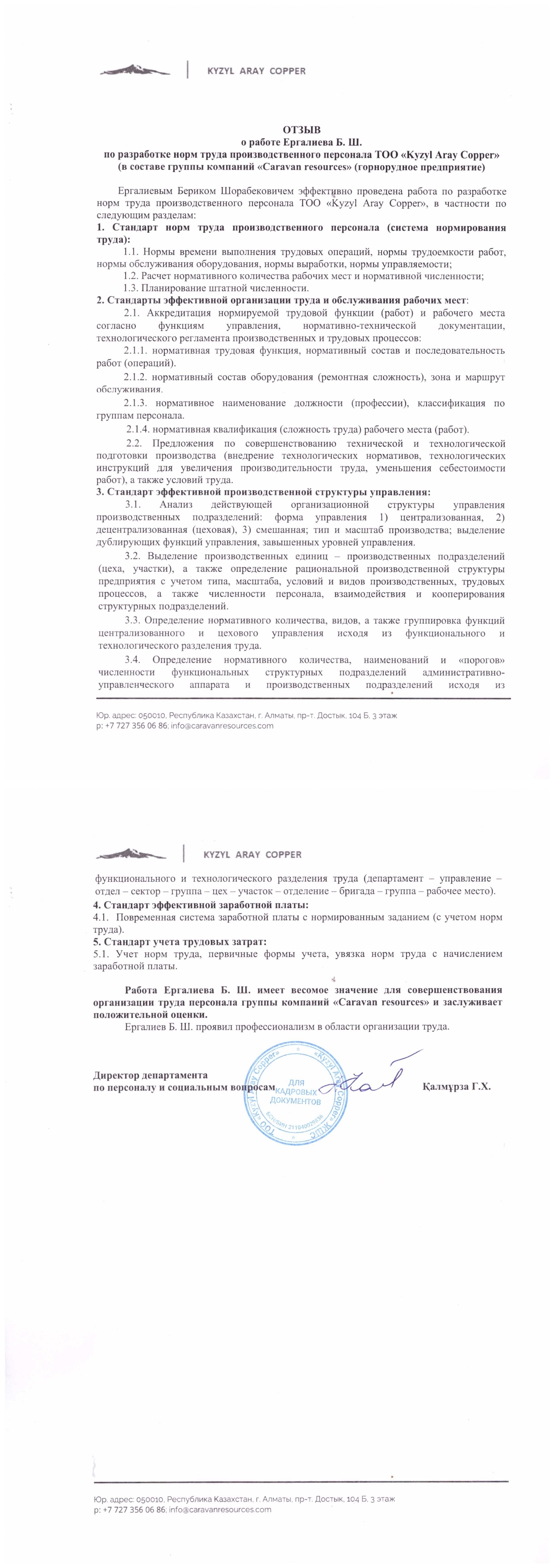
Kyzyl Aray Copper

Caravan Resources group, mining

Labor standards handbooks by division and workplace

labor standards (time, output, service, labor-intensity, span-of-control standards); standard headcount (on-duty, relief, payroll) by workplace with calculation methodology · rational production structure and management levels · workplace service organization, equipment grouping, repair complexity · optimal work regime and shift schedule · pay for a standardized task · labor accounting

2024

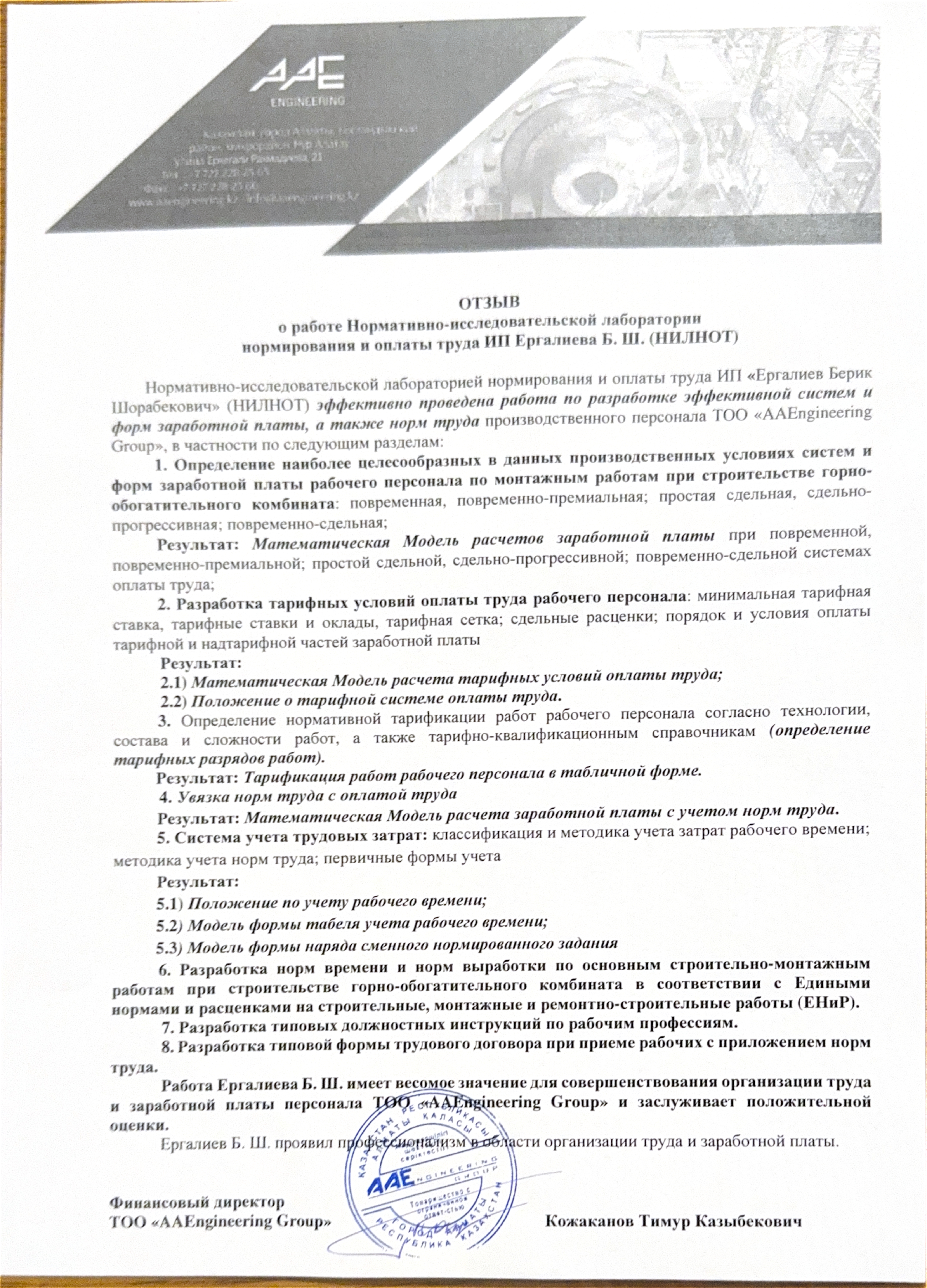
AAEngineering Group LLP

construction and installation works, construction of a mining and processing plant

Effective pay system and labor standards for workers

labor standards linked to pay — mathematical wage calculation model

time and output standards for main construction and installation works (using ENiR) · work grading per ETKS · tariff terms: minimum tariff rate, tariff rates and salaries, tariff scale, piece rates, Regulation on the tariff pay system · pay systems: time-bonus, piece-rate, progressive piece-rate, time-piece — mathematical wage calculation models · labor accounting: Regulation on working time accounting, timesheet and standardized shift task work order models · standard job descriptions for blue-collar trades, standard employment contract with labor standards attached

2024

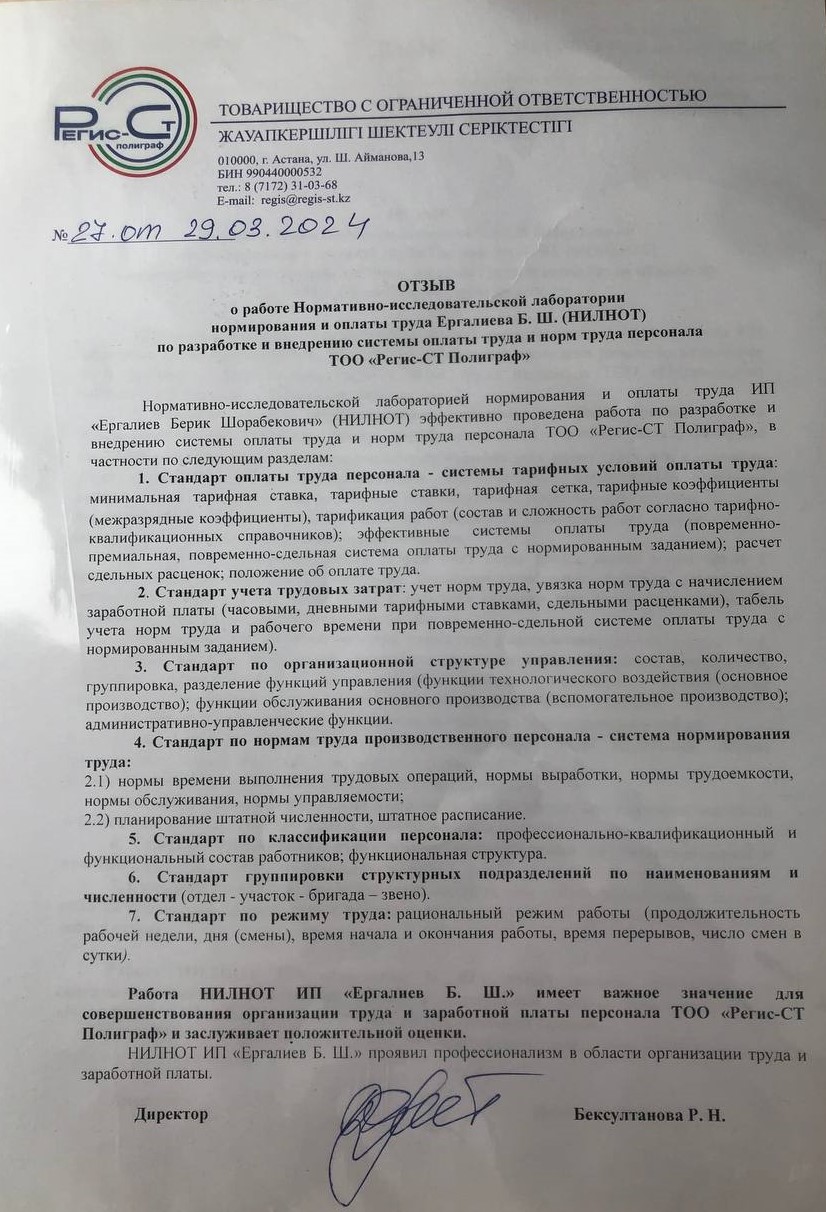
Regis-ST Polygraph LLP

printing

Handbook of time standards for production workers with calculation methodology (Excel model)

labor standards (time, output, labor-intensity, service standards) by operation and equipment; standard headcount (on-duty, relief, payroll) by workplace with calculation methodology, draft staffing table · functional structure, rational organizational management structure, grouping of divisions, span-of-control standards · optimal work regime and shift schedule · personnel classification · Regulation on pay, tariff scale, work grading per ETKS · time-piece pay, wage calculation for workers, standard employment contract · timesheet instruction and model

2023–20176 projects
2023

Kazteleradio JSC

TV and radio broadcasting

Headcount standards approved by the Ministry of Labor and Social Protection of the Population of Kazakhstan

labor standards handbook: service standards for telecommunication equipment of satellite and terrestrial networks, span-of-control standards; standard headcount (on-duty, relief, payroll) by function and workplace with calculation methodology — head office administrative staff and production staff of branches · draft staffing table · rational management structure of head office and branches (incl. production structure) · personnel classification · optimal shift and rotational work regime · tariff pay terms · standard labor cost calculation for the tariff estimate · labor accounting

2023

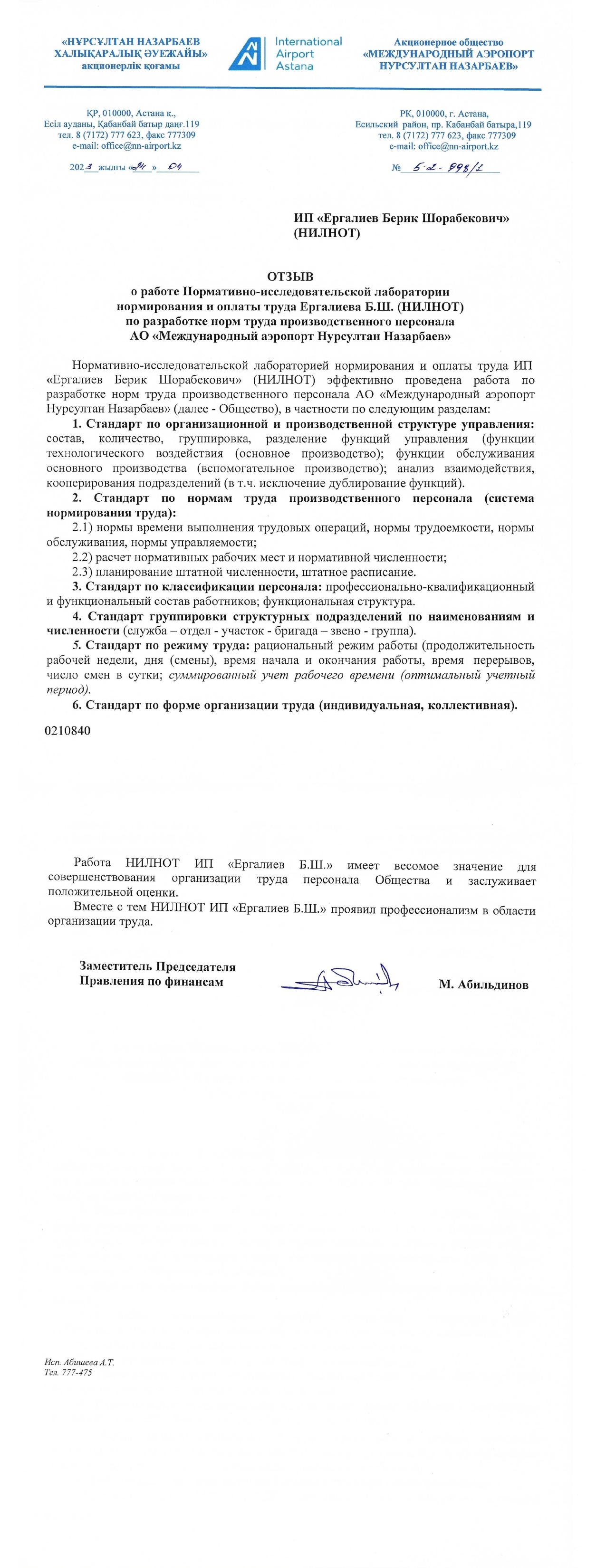
Nursultan Nazarbayev International Airport

airport operations

Standard headcount and draft staffing table for all airport services

labor standards (time, service, labor-intensity, span-of-control standards); standard headcount (on-duty, relief, payroll) by workplace with calculation methodology, draft staffing table · standards: management functions, rational organizational and production structure of services per ICAO standards, grouping of divisions by headcount, span-of-control standards · individual and team forms of labor organization · optimal shift regime, summarized working time accounting with a justified accounting period · personnel classification · equipment grouping · tariff terms: minimum tariff rate, consolidated tariff scale, unified payroll structure · labor accounting

2022

Green Recycle — KAZ Waste Green Energy

municipal solid waste processing

Labor standards, standard headcount and tariff system

labor standards (time, output, service, labor-intensity, span-of-control standards); standard headcount of production and administrative staff with calculation methodology · functional division of labor, rational structure, grouping of divisions · optimal work regime · individual and team forms of labor organization, Regulation on the production team · tariff system: minimum tariff rate, tariff scale model, Regulation on pay, Regulation on the tariff and qualification commission · labor accounting · staff training

2019

A. Kasteyev State Museum of Arts

culture

Labor standards

time standards and standard headcount with calculation methodology for 3D modeling of cultural and historical heritage objects

2017

Batumi Oil Terminal

KazTransOil group, oil transshipment

Labor standards and standard headcount of workers, specialists and managers

labor standards (time, service, span-of-control standards) for workers, specialists and managers; standard headcount (on-duty, relief, payroll) by function with calculation methodology · rational production structure · equipment grouping, repair complexity · optimal work regime, working time balance · personnel classification, tariff terms · Regulation on labor standardization

2017

Batumi Sea Port

KazTransOil group, sea port

Labor standards and standard headcount of workers, specialists and managers

labor standards (time, service, span-of-control standards) for workers, specialists and managers; standard headcount (on-duty, relief, payroll) by function with calculation methodology · rational production structure · equipment grouping, repair complexity · optimal rotation and shift regime · personnel classification, tariff terms

2014–200711 projects
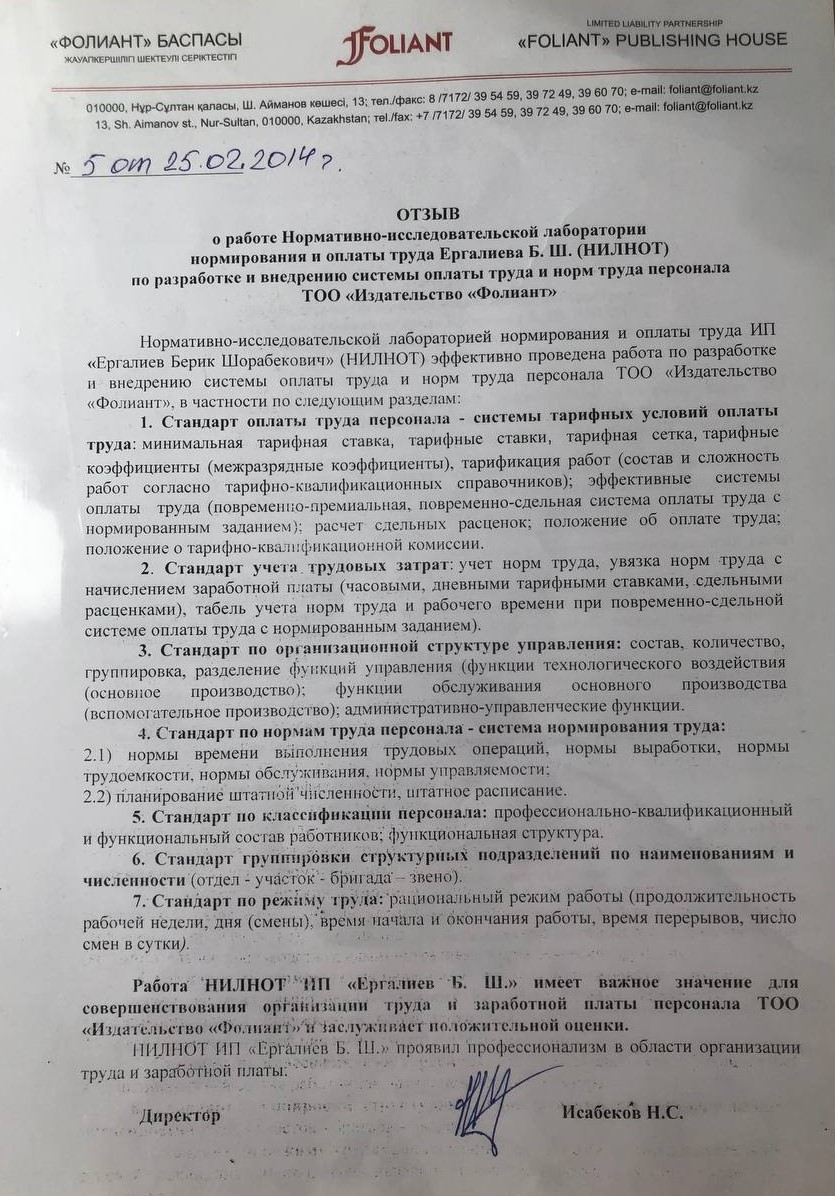
2014

Foliant Publishing House

printing

Labor standards, tariff pay terms and labor cost accounting

labor standards (time, output, service, labor-intensity, span-of-control standards); standard headcount (on-duty, relief, payroll) by workplace with calculation methodology · rational structure · optimal work regime · personnel classification · tariff terms, pay for a standardized task · labor accounting

2013

Medicus-Centre LLP

distribution of medical products, warehouses in Almaty and Astana

Labor standards for warehouse staff

labor standards handbook with calculation methodology (mathematical model)

time and output standards for warehouse operations: receiving and placement, order picking (small-wholesale, non-standard, pallet warehouses), replenishment, packing, shipping, barcoding, returns; span-of-control standards; standard headcount (on-duty, relief, payroll) by warehouse section with calculation methodology, draft staffing table with tariff grades · training in the labor standards calculation methodology

2013

Eurobakery and Thomis Pastry LLP

culinary, confectionery and bakery shops

Labor standards and tariff pay terms for workers

time standards for dishes and products based on process sheets

process sheets and time standards for dishes (culinary shop), confectionery and bakery products; labor intensity by sales volume; standard headcount of cooks and shop workers with calculation methodology · span-of-control standards · tariff pay terms for workers

2010–2014

KMG Refining and Marketing JSC: Atyrau Refinery, Pavlodar Petrochemical Plant, PetroKazakhstan Oil Products, KMG Onimderi, Akbulak resort

oil refining and petroleum product supply, commissioned by Samruk-Kazyna

Unified regulatory base for refineries, filling stations, tank farms and the group resort; standards in use for over 10 years

labor standards (time, labor-intensity, service standards) for refinery process units, filling stations and tank farms; standard number of workplaces and standard headcount of workers and engineering staff (on-duty, relief, payroll) with calculation methodology · standard rational production structure: assignment of processes to core and auxiliary production · equipment grouping, repair complexity per PPM · optimal work regime, working time balance · classifier of trades and positions, minimum tariff rate, tariff scale, Regulation on pay · timesheet accounting · specialist training

2011

Almaty Heating Networks JSC

heat supply

Labor standards and piece-rate pay for repair staff

piece-rate pay based on time standards approved by the client

time, service and span-of-control standards for heating network works (pipeline replacement, earthworks, heat chamber maintenance); standard headcount with calculation methodology, working time loss coefficient · team and individual piece rates, piece-work order · recommendations on pay forms and systems

2010

Helios LLP

filling station network

Rational work and rest regime and labor accounting for filling station staff

optimal shift schedules for 24/7 filling station operation (mathematical model)

time standards for vehicle fueling and cash operations, filling station throughput; standard headcount of 24/7 filling station staff with calculation methodology · optimal work and rest regime, intra-shift regime, Regulation on working time and rest time · summarized working time accounting, timesheet instruction and form · alignment of HR and payroll accounting, incl. overtime

2009

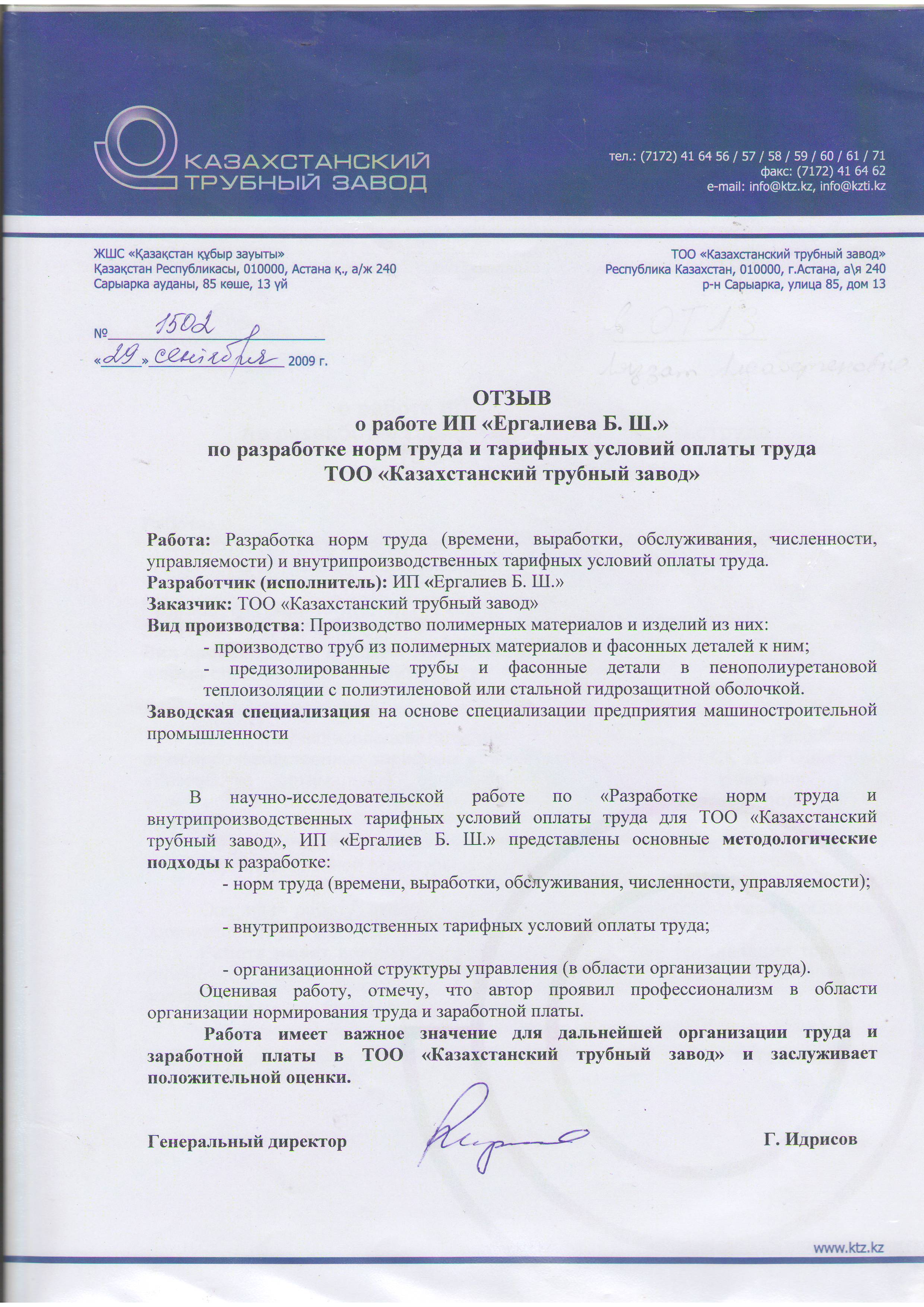
Kazakhstan Pipe Plant LLP

polymer pipe production

Labor standards, standard headcount and tariff pay terms

labor standards (time, output, service, span-of-control standards); standard headcount with calculation methodology · rational management structure · tariff pay terms

2009

Petropavlovsk Building Materials Plant LLP

building materials production

Labor standards and tariff pay terms

labor standards (time, output, service standards) for production workers; standard headcount with calculation methodology · tariff pay terms: minimum tariff rate, tariff scale, work grading per ETKS, piece rates

2009

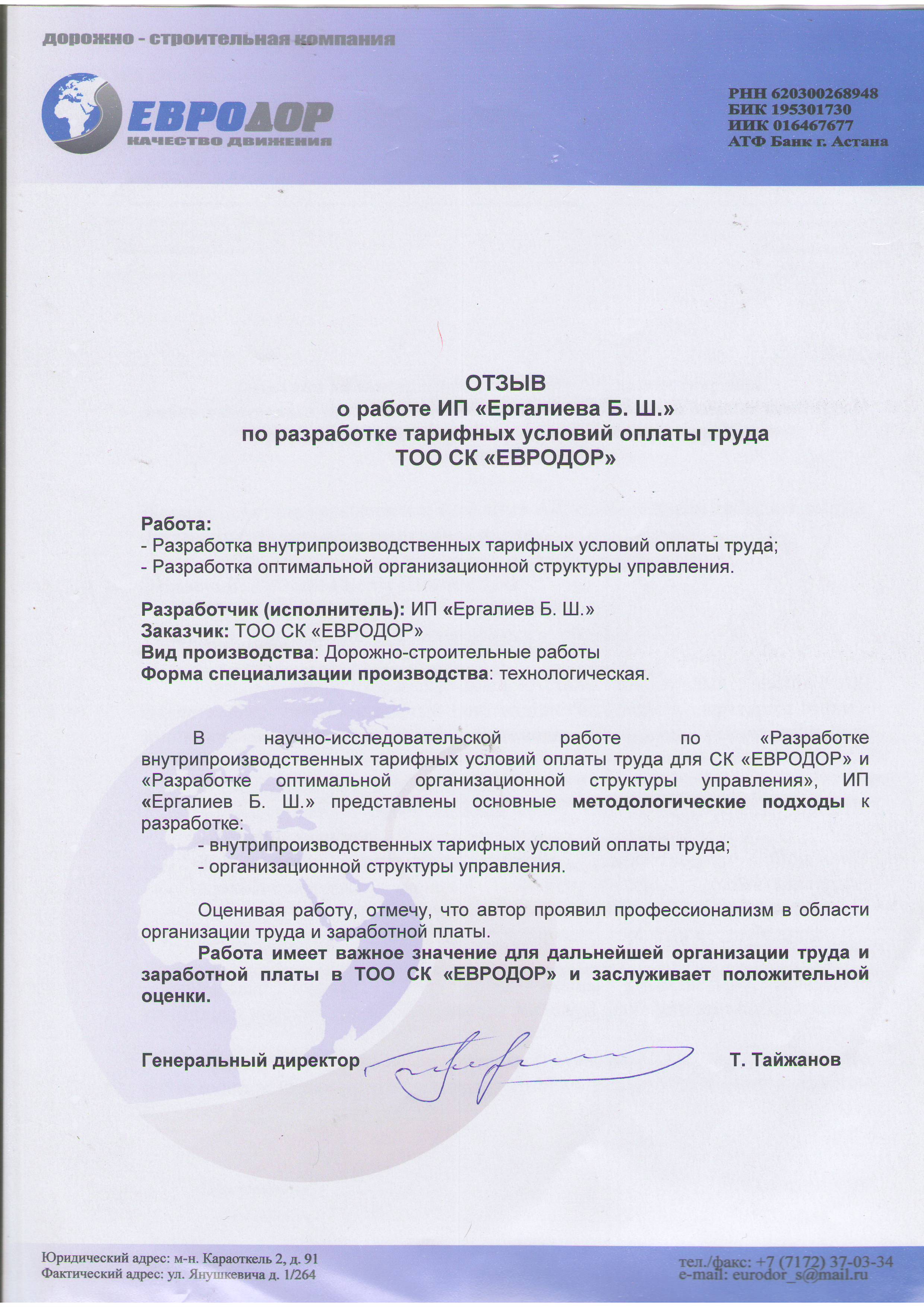
Eurodor Construction Company LLP

road construction

Tariff pay terms

tariff pay terms methodology with calculation methodology: minimum tariff rate, tariff scale, grading of workers’ jobs per ETKS and positions per KS, differentiation of rates and salaries by job complexity, Regulation on pay · rational management structure

2008

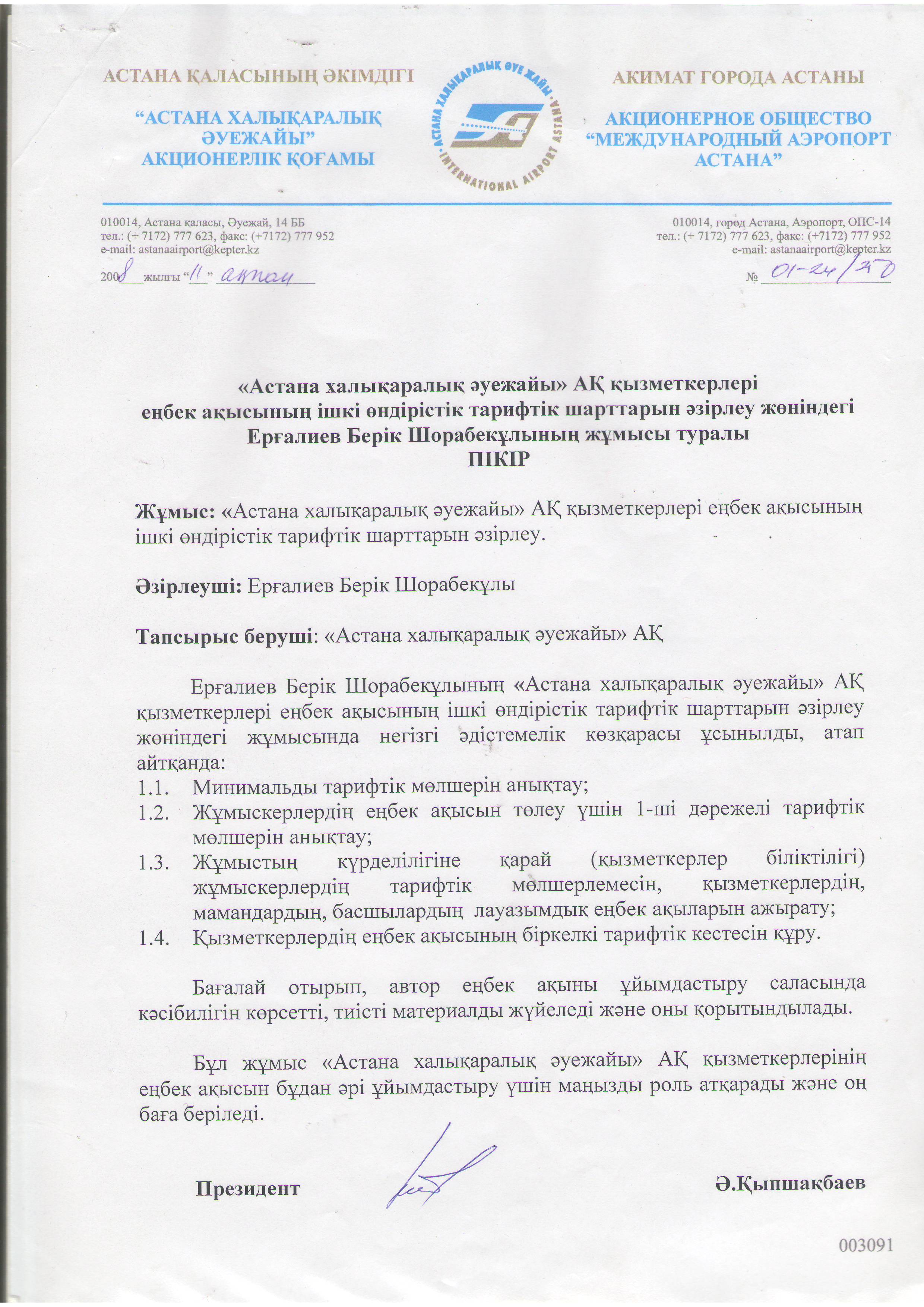
Astana International Airport JSC

airport operations

Tariff pay terms

tariff pay terms methodology with calculation methodology: minimum tariff rate, grade 1 tariff rate, inter-grade tariff coefficients, differentiation of rates and salaries by job complexity, unified tariff scale for workers, specialists and managers · grading of jobs and positions per ETKS and KS

2007

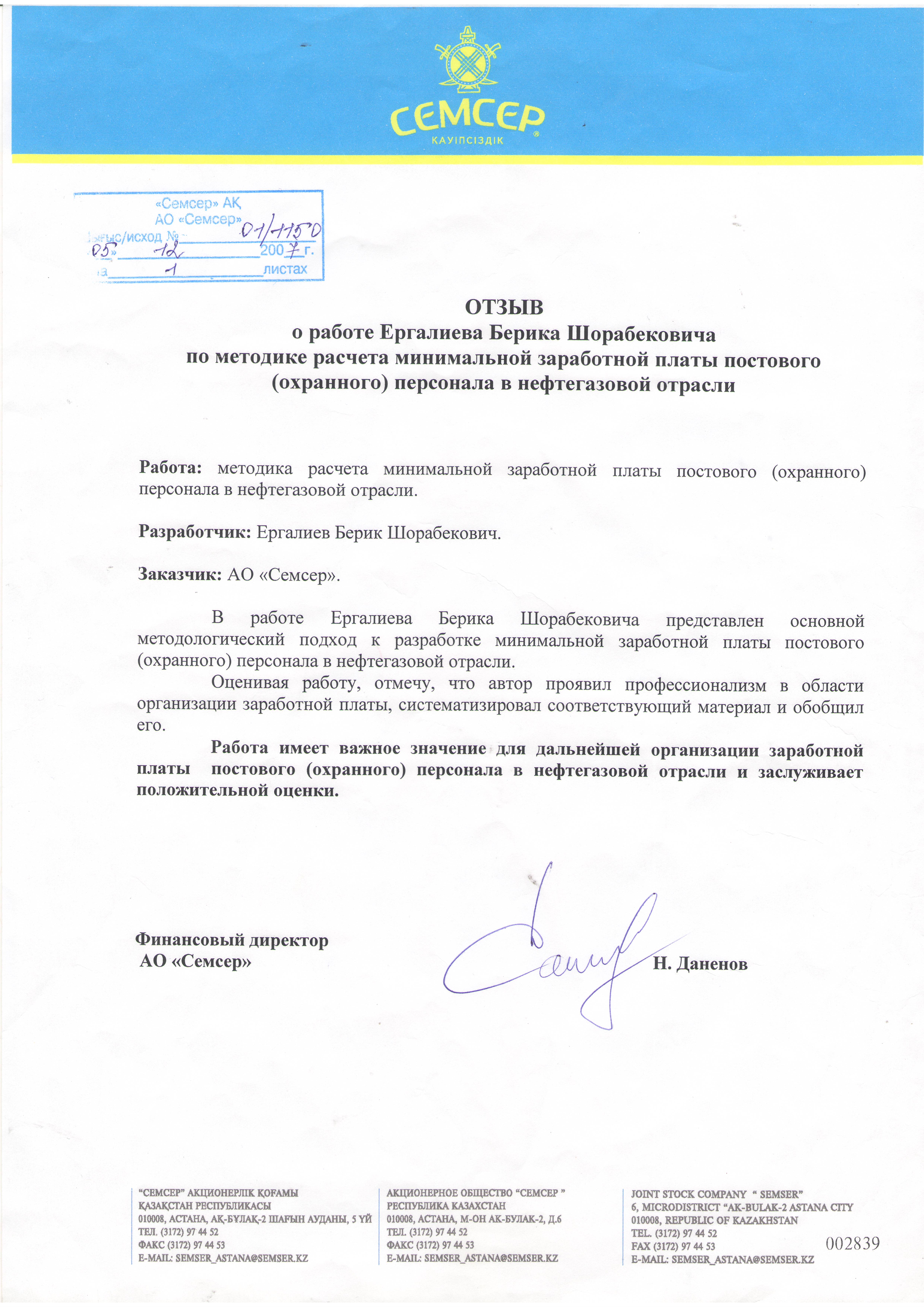
Semser JSC

security of oil and gas facilities

Tariff pay terms

methodology for calculating the minimum wage of guard staff based on post regime, working conditions and qualification requirements

References

Client references

Reference letters on client letterheads — click to open the scan.

Documents

Presentation and proposal

NILNOT PresentationLabor productivity growth without capital investment · 9 pages

EN KZ RU

NILNOT ProposalEngineering System of Production and Labor Organization · 2 pages

EN KZ RU

Contacts

Request a commercial proposal

Head
Berik Yergaliyev
Phone, WhatsApp
+7 701 999 85 93
Email
nilnotber@gmail.com
Address
Almaty, Kazakhstan
Profiles
LinkedIn · Google · 2GIS

Pilot project — one or two divisions; the cost of the pilot is credited towards the cost of work for the enterprise as a whole. Timing and cost — individually.

WhatsApp